- Have any Questions?
- +919446239984
- +918593933100
- info@monarchdentalcare.in

Dental Implants vs Dental Bridges: Which Is Better for Missing Teeth?
Hello world!
June 12, 2018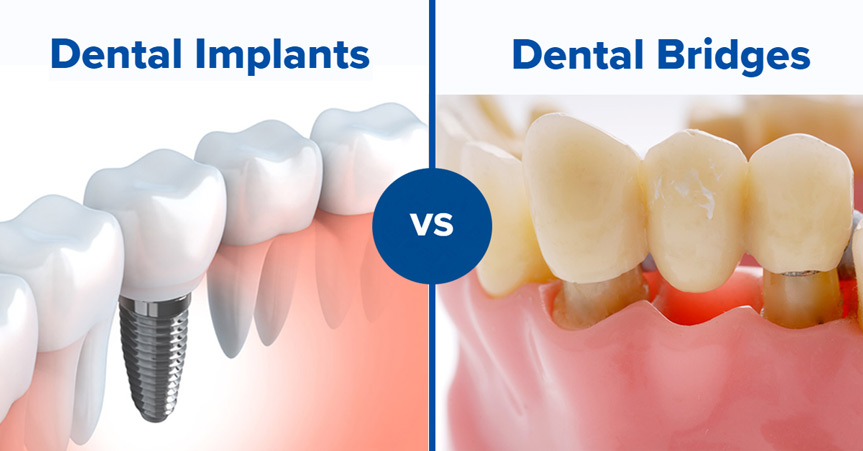
Losing a tooth can affect much more than your smile. It may change the way you chew, speak, and even how the surrounding teeth function over time.
Two of the most common options for replacing missing teeth are dental implants and dental bridges.
But which one is better?
The answer depends on several factors, including your oral health, the number and location of missing teeth, the condition of nearby teeth, bone availability, treatment time, and your dentist’s clinical assessment.
Both options can restore appearance and function, but they work in very different ways.
What Is a Dental Implant?
A dental implant is an artificial tooth root, usually made from titanium, that is surgically placed into the jawbone.
After the implant integrates with the surrounding bone, it is restored with a dental crown that looks and functions like a natural tooth.
A dental implant typically includes:
- The implant placed in the jawbone
- An abutment that connects the implant and crown
- A dental crown that replaces the visible part of the tooth
Implants can be used to replace a single tooth, multiple teeth, or even support larger restorations in patients with several missing teeth.
What Is a Dental Bridge?
A dental bridge replaces a missing tooth by using the teeth next to the gap for support.
In a conventional bridge, the neighbouring teeth are prepared and fitted with crowns. An artificial tooth, known as a pontic, fills the missing space between them.
Different types of bridges are available depending on the location of the missing tooth and the condition of the surrounding teeth.
Dental Implant vs Dental Bridge: What Is the Main Difference?
The biggest difference is how the replacement tooth is supported.
A dental implant is supported directly by the jawbone and does not usually require preparation of the neighbouring teeth.
A traditional dental bridge, on the other hand, relies on adjacent teeth for support.
This difference affects treatment planning, maintenance, longevity, and the impact on surrounding teeth.
1. Impact on Neighbouring Teeth
One of the major advantages of a dental implant is that healthy neighbouring teeth generally do not have to be cut down to support the restoration.
With a conventional bridge, the teeth on either side of the gap usually need to be prepared so that crowns can be placed over them.
If the neighbouring teeth are already heavily filled or require crowns, a bridge may sometimes be a practical option.
However, if the adjacent teeth are healthy, preserving their natural structure may make an implant more attractive.
2. Bone Preservation
When a tooth is lost, the bone that previously supported its root may gradually reduce over time.
Because a dental implant is placed within the jawbone, it can help maintain stimulation in that area and support bone preservation.
A bridge replaces the visible portion of the missing tooth but does not replace the tooth root.
For this reason, bone changes can still occur underneath the bridge.
3. Treatment Time
Dental bridges can often be completed more quickly than dental implants.
A bridge may require preparation of the supporting teeth, impressions or digital scans, and placement of the final restoration over a relatively short treatment period.
Dental implants usually take longer because the implant needs time to integrate with the jawbone before the final crown is placed.
In some patients, additional procedures such as bone grafting may also be required.
The exact treatment time varies depending on the individual case.
4. Surgical Procedure
Dental implant placement involves a minor surgical procedure.
For many patients, implant surgery is straightforward, but suitability depends on general health, oral health, bone condition, and other clinical factors.
A conventional dental bridge generally does not require implant surgery.
For patients who cannot undergo implant surgery or prefer a non-surgical option, a bridge may be considered.
5. Appearance and Natural Feel
Both dental implants and modern dental bridges can provide highly natural-looking results.
Dental implants are often appreciated because the replacement tooth functions independently and can feel similar to a natural tooth once properly restored.
A well-designed bridge can also provide excellent cosmetic results, particularly when the colour, shape, and contour are carefully matched to the surrounding teeth.
The final appearance depends significantly on treatment planning, materials, gum condition, and the quality of the restoration.
6. Cleaning and Maintenance
Dental implants are generally cleaned in a way similar to natural teeth, although special attention must be given to the gum line around the implant.
Regular brushing, interdental cleaning, and dental check-ups are essential.
Cleaning under a dental bridge requires additional care because the artificial tooth is connected to the supporting crowns.
Special floss, interdental brushes, or other cleaning aids may be recommended to remove plaque beneath the bridge.
Good oral hygiene is important for both options.
7. Longevity
Both dental implants and dental bridges can last for many years when properly planned, placed, restored, and maintained.
Dental implants may offer excellent long-term performance, particularly when the patient maintains good oral hygiene and regular dental care.
Dental bridges can also remain functional for many years, but their long-term success also depends on the health of the supporting teeth.
Decay, gum disease, or damage affecting one of the supporting teeth may compromise the bridge.
There is no single lifespan that applies to every patient or restoration.
8. Suitability for Different Patients
Dental implants may be suitable for patients who:
- Have one or more missing teeth
- Have adequate jawbone or are suitable for bone augmentation
- Have healthy gums
- Want to avoid preparing healthy neighbouring teeth
- Are medically suitable for implant surgery
- Are willing to undergo a longer treatment process
Dental bridges may be suitable for patients who:
- Have one or more missing teeth
- Have neighbouring teeth that already require crowns or significant restoration
- Prefer a treatment that may be completed more quickly
- Are not suitable candidates for implant surgery
- Have bone limitations that make implant treatment more complex
- Prefer a non-implant restoration
How Does a Dentist Decide Which Option Is Right for You?
Before recommending an implant or bridge, your dentist may assess:
- Number of missing teeth
- Position of the missing tooth
- Health of neighbouring teeth
- Gum condition
- Jawbone quantity and quality
- Bite and chewing forces
- Medical history
- Smoking habits
- Previous dental treatment
- Long-term restorative goals
Dental X-rays and, in selected implant cases, three-dimensional imaging may also be used for treatment planning.
Dental Implants or Dental Bridges: Which Is Better?
There is no single solution that is best for every missing tooth.
Dental implants may be ideal when you want an independent tooth replacement without preparing healthy neighbouring teeth and when your bone and oral health are suitable.
Dental bridges can be an excellent option when adjacent teeth require restoration, when implant surgery is unsuitable, or when a quicker fixed replacement is preferred.
The most important factor is proper diagnosis and treatment planning.
If you have one or more missing teeth, speak with your dentist about all available replacement options. A personalised evaluation can help you choose the treatment that provides the right balance of function, appearance, durability, and long-term oral health.
Replace the gap. Restore your function. Protect your smile.
